
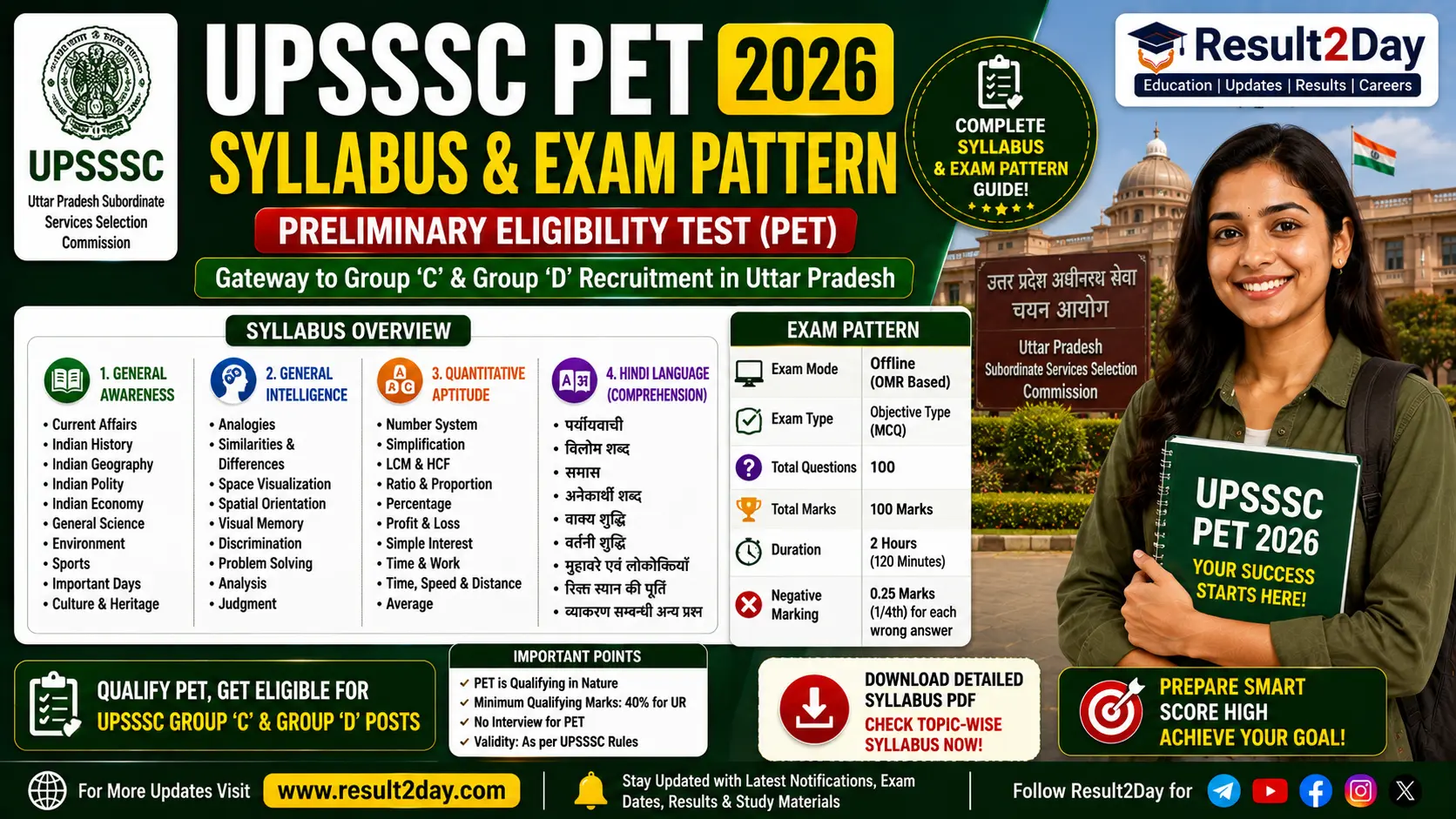
The UPSSSC PET Syllabus 2026 is important for candidates preparing for the Uttar Pradesh Subordinate Services Selection Commission’s Preliminary Eligibility Test. PET acts as an eligibility or screening examination for various UPSSSC Group C recruitment processes, so a good PET score can be useful when candidates later apply for posts for which PET is required.
The Uttar Pradesh Subordinate Services Selection Commission has started the UPSSSC PET 2026 application process. Candidates should now begin preparation according to the prescribed syllabus instead of waiting until the examination is close. The 2026 registration process began on August 3, 2026, and the reported last date for submitting applications is September 1, 2026.
Latest Update: UPSSSC PET 2026 registration is currently underway. Candidates preparing for the examination should check the official UPSSSC website regularly for the latest notification, correction facility, admit card and examination updates. The Commission has also released its 2026 examination calendar.
The PET paper generally tests candidates across history, national movement, geography, economy, Constitution and public administration, science, arithmetic, Hindi, English, reasoning, current affairs, general awareness and data interpretation. The standard examination structure consists of 100 objective questions carrying 100 marks, with a duration of two hours and negative marking for incorrect answers.
For candidates targeting future UPSSSC recruitment such as Junior Assistant, Lekhpal, VDO and other posts where PET qualification is prescribed, understanding the syllabus is especially important. PET itself does not directly appoint a candidate to a particular post; instead, its score is used as part of the eligibility or shortlisting process for applicable future recruitments.
UPSSSC PET 2026 – Overview
| Particular | Details |
|---|---|
| Exam Name | Uttar Pradesh Subordinate Services Selection Commission Preliminary Eligibility Test |
| Popular Name | UPSSSC PET 2026 / UP PET 2026 |
| Conducting Authority | Uttar Pradesh Subordinate Services Selection Commission |
| Exam Level | State Level |
| Exam Mode | Offline / OMR Based |
| Question Type | Objective Multiple Choice Questions |
| Total Questions | 100 |
| Total Marks | 100 |
| Exam Duration | 2 Hours |
| Negative Marking | 1/4 Mark for each incorrect answer |
| Medium | Hindi and English |
The current syllabus structure gives candidates a fairly broad paper rather than concentrating on one subject. Therefore, preparation should be balanced. Ignoring smaller sections can also reduce the overall score because the paper distributes marks across many areas.
UPSSSC PET Exam Pattern 2026
The UPSSSC PET Exam Pattern 2026 consists of 100 objective-type questions. Each question carries one mark, making the maximum score 100 marks. Candidates get two hours to complete the paper.
The examination also includes negative marking. One-fourth mark is deducted for every incorrect answer under the standard PET marking scheme. This makes accuracy an important part of the preparation strategy.
| Exam Feature | Details |
|---|---|
| Type of Questions | Objective Multiple Choice Questions |
| Total Questions | 100 |
| Maximum Marks | 100 |
| Duration | 2 Hours |
| Correct Answer | +1 Mark |
| Incorrect Answer | -1/4 Mark |
| Exam Mode | Offline OMR Based |
UPSSSC PET Subject Wise Question Distribution
The PET syllabus contains several small five-mark areas along with larger sections carrying ten marks each. Current syllabus references list 15 subject areas that together make 100 questions and 100 marks.
| Subject | Questions / Marks |
|---|---|
| Indian History | 5 Questions / 5 Marks |
| Indian National Movement | 5 Questions / 5 Marks |
| Geography | 5 Questions / 5 Marks |
| Indian Economy | 5 Questions / 5 Marks |
| Indian Constitution & Public Administration | 5 Questions / 5 Marks |
| General Science | 5 Questions / 5 Marks |
| Elementary Arithmetic | 5 Questions / 5 Marks |
| General Hindi | 5 Questions / 5 Marks |
| General English | 5 Questions / 5 Marks |
| Logic & Reasoning | 5 Questions / 5 Marks |
| Current Affairs | 10 Questions / 10 Marks |
| General Awareness | 10 Questions / 10 Marks |
| Hindi Unseen Passage | 10 Questions / 10 Marks |
| Graph Analysis & Interpretation | 10 Questions / 10 Marks |
| Table Analysis & Interpretation | 10 Questions / 10 Marks |
UPSSSC PET Syllabus 2026 – Subject Wise
The UPSSSC PET Syllabus 2026 is based on a mixture of school-level academic subjects, general studies, language, reasoning and data interpretation. The syllabus is broad, but many topics are familiar to candidates who have prepared for other government examinations.
1. Indian History
The Indian History section tests basic knowledge of important developments in India’s past. Candidates should focus on major periods and events rather than attempting to memorise every historical date.
Important areas include the Indus Valley Civilisation, Vedic culture, Buddhism and Jainism, Mauryan and Gupta periods, medieval Indian history, Delhi Sultanate, Mughal period, British rule and important historical developments.
Candidates should also revise major rulers, administrative systems, cultural developments, important monuments and significant events associated with different periods of Indian history.
2. Indian National Movement
This section focuses on India’s struggle for independence. Candidates should understand the major stages of the national movement and the role played by important organisations and leaders.
Important areas include the Revolt of 1857, formation of the Indian National Congress, major movements under Mahatma Gandhi, Non-Cooperation Movement, Civil Disobedience Movement, Quit India Movement, revolutionary activities and important developments leading to independence.
Rather than memorising isolated facts, candidates should understand the sequence of major events and their significance.
3. Geography
The Geography section covers fundamental concepts related to India and the world, with particular importance given to Indian geography.
Candidates should revise physical features of India, rivers, mountains, climate, soils, natural vegetation, agriculture, minerals, industries, population and major geographical resources.
Maps can be useful during preparation because they help candidates remember locations of rivers, mountain ranges, states, mineral-producing areas and important geographical regions.
4. Indian Economy
For Indian Economy, candidates should focus on basic economic concepts and major developments in the Indian economy. The objective is to understand how the economy functions rather than studying advanced economics.
Important areas include national income, sectors of the economy, poverty, unemployment, inflation, banking, taxation, government budget, economic planning and major government economic programmes.
Current economic developments should also be followed because the examination includes a separate Current Affairs section.
5. Indian Constitution and Public Administration
This section covers fundamental knowledge of the Indian Constitution and the basic functioning of public administration.
Candidates should revise the Constitution, fundamental rights, directive principles, fundamental duties, Parliament, President, Prime Minister, Supreme Court, High Courts, state government, local government and constitutional institutions.
Public administration preparation should include basic administrative structure, governance, responsibilities of government institutions and important constitutional provisions.
6. General Science
General Science includes basic concepts from Physics, Chemistry and Biology. The questions are generally intended to test everyday scientific understanding and fundamental concepts.
Physics preparation can include motion, force, work, energy, electricity, light and sound. Chemistry can include matter, elements, compounds, acids, bases and common chemical processes. Biology preparation should cover human body systems, nutrition, diseases, plants, animals and basic life processes.
7. Elementary Arithmetic
Elementary Arithmetic is a scoring area for candidates who practise regularly. Important topics include number system, percentage, ratio and proportion, average, profit and loss, simple interest, time and work, time and distance and basic numerical calculations.
The emphasis should be on accuracy and speed. Candidates should learn standard methods and practise questions under a time limit.
8. General Hindi
General Hindi tests basic language understanding and usage. Candidates should revise grammar, vocabulary and sentence-related concepts.
Preparation can include पर्यायवाची, विलोम शब्द, मुहावरे, संधि, समास, वाक्य शुद्धि, शब्द शुद्धि and other standard Hindi grammar topics relevant to competitive examinations.
9. General English
General English covers basic language skills. Candidates should prepare grammar, vocabulary and comprehension-related topics.
Important areas can include parts of speech, tenses, articles, prepositions, synonyms, antonyms, sentence correction, fill in the blanks and basic reading comprehension.
10. Logic and Reasoning
Logic and Reasoning evaluates the candidate’s ability to identify patterns and relationships. Regular practice is more useful than simply reading reasoning concepts.
Important topics include analogy, classification, series, coding-decoding, direction sense, blood relations, ranking, syllogism, statements and conclusions and other basic logical reasoning questions.
Candidates should gradually increase speed while ensuring that accuracy does not fall because of rushed attempts.
UPSSSC PET Syllabus 2026 – Remaining Subjects
The remaining sections of the UPSSSC PET Syllabus 2026 are especially important because Current Affairs, General Awareness and data interpretation together carry a significant number of marks. Candidates should not leave these areas for the final days of preparation.
11. Current Affairs
The Current Affairs section carries 10 marks and can include important national and international developments. Candidates should regularly follow major events related to government policies, awards, appointments, sports, science and technology, important days and significant national developments.
For UPSSSC PET preparation, candidates should give additional attention to developments related to Uttar Pradesh. Important state government schemes, major projects, awards, appointments, economic developments and significant events can be included in regular current-affairs revision.
A practical approach is to prepare monthly current-affairs notes and revise them at regular intervals. Candidates should focus on important information rather than trying to remember every news event.
12. General Awareness
General Awareness is another 10-mark section. It is broader than Current Affairs and generally tests knowledge of commonly known facts about India, the world and important institutions.
Candidates can revise important countries and capitals, currencies, international organisations, national symbols, important institutions, awards, books and authors, sports events, important discoveries and other general knowledge areas.
Static General Knowledge should be revised repeatedly because these facts can be forgotten easily when there is a long gap between revisions.
13. Hindi Unseen Passage
The Hindi Unseen Passage section carries 10 marks and tests the ability to understand information presented in a passage. Candidates should read the passage carefully and answer questions according to the information given in it.
The most important skill here is comprehension. Candidates should avoid making assumptions that are not supported by the passage. Questions should be answered using the information and meaning contained in the given text.
Regular practice of Hindi passages can improve both reading speed and accuracy. Candidates can practise with short passages initially and gradually move to longer ones.
14. Graph Analysis and Interpretation
Graph Analysis and Interpretation carries 10 marks. This section tests the candidate’s ability to read graphical information and draw the correct conclusion from the data.
Preparation should include bar graphs, line graphs and other basic graphical representations that may require comparison, percentage calculation, difference or trend identification.
Candidates should first understand the units and labels shown on the graph. Many mistakes occur because a candidate begins calculating without properly reading the scale or categories.
15. Table Analysis and Interpretation
Table Analysis and Interpretation also carries 10 marks. Candidates are required to extract information from tables and perform basic calculations or comparisons.
Questions may involve totals, differences, ratios, percentages, averages or comparisons between different rows and columns. Regular practice is the best way to improve speed in this section.
Candidates should learn to identify exactly which figures are needed for a question instead of reading every value in the table unnecessarily.
UPSSSC PET Syllabus – Difficulty Level
The PET syllabus covers topics that are generally based on basic to moderate levels of knowledge. However, the broad syllabus can make the examination challenging because candidates need to prepare several subjects simultaneously.
The arithmetic and reasoning sections require practice, while history, geography, science, polity and economy require regular revision. Hindi and English can become scoring sections for candidates who are comfortable with language fundamentals.
Data interpretation requires a different approach. Candidates should practise solving questions quickly while carefully checking figures, units and calculations.
UPSSSC PET 2026 Preparation Strategy
A good preparation plan should divide the syllabus into manageable sections instead of attempting to complete the entire syllabus in a short period. Candidates should first identify the subjects in which they are already comfortable and then devote additional time to weaker areas.
Build a Subject-Wise Study Plan
Since the examination covers 15 areas, candidates should avoid studying only one subject throughout the week. A mixed timetable can help maintain continuity across different subjects.
For example, a candidate can study one general studies topic, one aptitude topic and one language or interpretation topic during the same study day. This keeps revision active across the syllabus.
Give Priority to High-Weightage Sections
Current Affairs, General Awareness, Hindi Unseen Passage, Graph Analysis and Table Analysis each carry 10 marks. Together, these areas account for a substantial portion of the paper.
However, candidates should not completely ignore the five-mark subjects. Since PET is a competitive screening examination, even a few additional marks can make a difference in the overall score.
Revise Static GK Regularly
History, geography, polity, science and economy contain many factual concepts. Reading these subjects once is not enough. Candidates should revise them repeatedly using short notes or topic-wise questions.
Practise Mathematics and Reasoning Daily
Arithmetic and reasoning improve through practice. Even 30 to 45 minutes of daily question solving can make a significant difference over several weeks.
After solving a practice set, candidates should check not only the correct answers but also the method used. If a question takes too much time, candidates should learn a shorter reliable approach.
UPSSSC PET Mock Test Strategy
Mock tests should be introduced after candidates have covered the basic syllabus. Initially, topic-wise tests can be used to strengthen individual subjects. Full-length tests should then be attempted under the actual two-hour time limit.
The objective of a mock test is not only to obtain a high score. Candidates should analyse where marks are being lost. A candidate who scores 65 marks but understands every mistake may improve faster than someone who scores 75 without analysing the paper.
Maintain a simple error record covering factual mistakes, calculation errors, questions misunderstood and questions that took excessive time. Review this record before subsequent mock tests.
UPSSSC PET Time Management
The paper contains 100 questions and candidates have two hours. This provides an average of approximately 72 seconds per question, although actual time requirements vary by subject.
Candidates should therefore avoid spending several minutes on a single difficult question. If a question is uncertain, it can be reviewed later if the examination procedure permits.
Language and factual questions can often be answered more quickly, while arithmetic and data interpretation may require additional time. Candidates should develop their own sequence through mock-test practice.
How to Improve UPSSSC PET Score
Improving the PET score requires a combination of knowledge, revision and accuracy. Candidates who already have a strong academic background should not assume that they can score well without practising the actual examination format.
Negative marking means careless attempts can reduce the final score. Candidates should therefore distinguish between questions they know, questions where they can eliminate options, and questions where they have no reasonable basis for choosing an answer.
Regular revision can also prevent avoidable mistakes. For example, a candidate may know a historical fact but choose the wrong option because two similar facts have not been revised properly. Short comparison notes can help in such situations.
UPSSSC PET Preparation for Hindi Medium Candidates
Candidates preparing in Hindi medium should focus on understanding the actual meaning of questions rather than translating every concept mentally into English. Hindi study material can be useful for subjects such as history, geography, polity and general awareness.
At the same time, candidates should practise the English section separately because familiarity with English grammar and vocabulary can improve accuracy in those questions.
UPSSSC PET Preparation for English Medium Candidates
English-medium candidates should also pay attention to the Hindi language section and Hindi unseen passage. The Hindi portion should not be ignored simply because the candidate is comfortable studying other subjects in English.
Regular Hindi reading and practice questions can improve comprehension speed and reduce mistakes.
UPSSSC PET 2026 Important Instructions
- Follow the latest official UPSSSC notification for examination-related information.
- Complete the syllabus before moving entirely to full-length mock tests.
- Revise Current Affairs and General Awareness regularly.
- Practise arithmetic and reasoning questions every day.
- Do not ignore Hindi and English because they carry separate marks.
- Practise graph and table interpretation with a timer.
- Analyse every mock test instead of checking only the final score.
- Remember the negative-marking rule while developing your attempt strategy.
- Use the official syllabus as the final checklist before the examination.
UPSSSC PET 2026 Revision Plan
| Preparation Stage | Main Focus |
|---|---|
| First Stage | Complete basic concepts and cover the full syllabus once |
| Second Stage | Topic-wise practice and revision of weak subjects |
| Third Stage | Full-length mock tests and detailed error analysis |
| Final Stage | Rapid revision, current affairs and important formulas/facts |
During the final stage, candidates should not start collecting multiple new books or preparation sources. The focus should be on revision of already studied material and improvement of examination performance.
UPSSSC PET Syllabus 2026 – What to Study First?
Candidates starting preparation from the beginning can first complete the basic concepts of Indian History, Geography, Constitution, Science and Elementary Arithmetic. These subjects form the foundation for several other government examinations as well.
After that, candidates can focus on reasoning, Hindi and English, followed by Current Affairs, General Awareness and data interpretation. This order is only a suggested approach; candidates who have strong or weak areas can adjust it according to their individual preparation level.
The important point is to avoid leaving the 10-mark sections until the end. Current Affairs and interpretation need repeated practice, so early preparation provides more opportunities for revision.
UPSSSC PET Exam Day Strategy
On the examination day, candidates should reach the centre according to the reporting instructions printed on the admit card. They should carry only the documents and permitted items specified by the examination authority.
Before marking answers on the OMR sheet, candidates should carefully follow the instructions regarding roll number, booklet details and answer marking. OMR-related mistakes can affect otherwise correct attempts.
During the paper, candidates should maintain a steady pace. If a question is taking too long, it is generally better to move ahead and return to it later rather than allowing one question to consume valuable examination time.
UPSSSC PET Syllabus 2026 – Final Preparation Advice
The PET syllabus is broad but manageable when divided into smaller sections. Candidates should not become overwhelmed by the number of subjects. Most areas involve basic concepts, factual revision or regular practice rather than advanced-level study.
A consistent daily routine is more useful than occasional long study sessions. Candidates should combine concept study with objective questions and regular revision. As the examination approaches, mock tests should become more frequent.
Most importantly, candidates should remember that PET is used for eligibility or shortlisting in applicable UPSSSC recruitments. A good PET score can therefore be valuable beyond the examination itself.
In the final weeks, candidates should focus on accuracy, revision and time management. The objective should be to convert the knowledge already gained into marks rather than continuously expanding the syllabus.
UPSSSC PET Syllabus 2026 – Official Important Links
Candidates preparing for the UPSSSC PET 2026 should use the official Uttar Pradesh Subordinate Services Selection Commission website for the latest notification, application information, admit card, answer key and examination updates. Any change in the examination schedule or rules should be verified from the latest official notice.
| Activity | Official Link |
|---|---|
| UPSSSC Official Website | Click Here |
| UPSSSC PET 2026 Notification | Click Here |
| UPSSSC PET Online Application | Click Here |
| UPSSSC Examination Updates | Click Here |
Useful Links
| Resource | Link |
|---|---|
| Result2Day Homepage | Visit Result2Day |
| Join Our WhatsApp Channel | Join WhatsApp Channel |
| Follow on Instagram | Follow on Instagram |
| Give Free Mock Test | Start Free Mock Test |
| Free Tools for Students | Explore Free Tools |
| All in One Calculator | Open Calculator |
UPSSSC PET Syllabus 2026 – FAQs
1. What is the UPSSSC PET Syllabus 2026?
Answer: The UPSSSC PET Syllabus 2026 covers Indian History, Indian National Movement, Geography, Indian Economy, Constitution and Public Administration, General Science, Elementary Arithmetic, General Hindi, General English, Logic and Reasoning, Current Affairs, General Awareness, Hindi Unseen Passage, Graph Analysis and Table Analysis.
2. How many questions are asked in the UPSSSC PET exam?
Answer: The PET examination consists of 100 objective-type questions carrying a total of 100 marks. Candidates are given two hours to complete the paper under the standard examination pattern.
3. What is the UPSSSC PET Exam Pattern 2026?
Answer: The standard PET pattern consists of 100 multiple-choice questions for 100 marks with a two-hour examination duration. The examination is conducted in offline OMR mode and includes negative marking for incorrect answers.
4. Is there negative marking in UPSSSC PET?
Answer: Yes. One-fourth mark is deducted for an incorrect answer under the standard PET marking scheme. Candidates should therefore attempt questions carefully and avoid unnecessary guessing.
5. Which subjects carry the highest marks in UPSSSC PET?
Answer: Current Affairs, General Awareness, Hindi Unseen Passage, Graph Analysis and Table Analysis each carry 10 marks under the standard syllabus distribution. These sections together account for a significant part of the paper.
6. Is UPSSSC PET difficult?
Answer: The individual topics are generally manageable, but the syllabus is broad because it includes several subjects. Regular revision, objective question practice and mock tests can make preparation more manageable.
7. Is UPSSSC PET compulsory for all UPSSSC jobs?
Answer: PET is used as an eligibility or screening requirement for applicable UPSSSC Group C recruitments. It is not necessarily required for every government job in Uttar Pradesh. Candidates should check the notification of the specific recruitment they want to apply for.
8. How should I prepare for UPSSSC PET 2026?
Answer: Start by completing the basic concepts of the syllabus, then practise subject-wise questions and revise regularly. Give special attention to current affairs, general awareness, arithmetic, reasoning and data interpretation, and gradually introduce full-length mock tests.
9. How many hours should I study for UPSSSC PET?
Answer: The required study time depends on your existing preparation level. A consistent daily schedule is more important than a fixed number of hours. Candidates should divide their time between syllabus coverage, question practice, current affairs and revision.
10. Where can I check the official UPSSSC PET syllabus?
Answer: Candidates should visit the official UPSSSC website and download the latest PET notification or syllabus document. The official Commission notification should always be treated as the final authority if any difference appears between different online sources.
Conclusion
The UPSSSC PET Syllabus 2026 provides a clear roadmap for candidates preparing for the Preliminary Eligibility Test. Since PET can be used for eligibility or shortlisting in applicable UPSSSC Group C recruitments, preparation for the examination can be useful for candidates planning a longer-term government-job career in Uttar Pradesh.
The paper covers a wide range of subjects, but most topics can be prepared with a systematic approach. Candidates should first understand the syllabus and exam pattern, then divide the subjects into small daily targets. History, geography, polity, economy and science require regular revision, while arithmetic, reasoning and data interpretation require consistent practice.
Current Affairs and General Awareness should also receive regular attention. Candidates preparing specifically for Uttar Pradesh government recruitment should keep an eye on important developments related to Uttar Pradesh along with national current affairs.
One of the most important aspects of PET preparation is accuracy. Because the examination includes negative marking, blindly attempting questions can reduce the final score. Candidates should use mock tests to develop a sensible attempt strategy and learn how to manage the two-hour examination effectively.
Another important point is that candidates should not confuse PET qualification with direct selection for a particular UPSSSC post. PET is used for applicable recruitment processes, while individual posts can have their own written examinations, skill tests, document verification or other selection stages. Candidates should therefore read the notification of each subsequent recruitment carefully.
As the UPSSSC PET 2026 examination approaches, the focus should gradually shift from completing new material to revision and practice. Candidates who have completed the syllabus should spend more time solving previous questions, taking mock tests and reviewing mistakes.
Finally, always verify the latest examination schedule, application instructions, syllabus and other important information through the official UPSSSC website. Government examination rules can change through subsequent notices, so the latest official communication should take priority over older information.
For candidates preparing seriously for UPSSSC recruitment, the best strategy is simple: understand the syllabus, study consistently, practise questions, revise repeatedly and protect your score by avoiding careless mistakes.